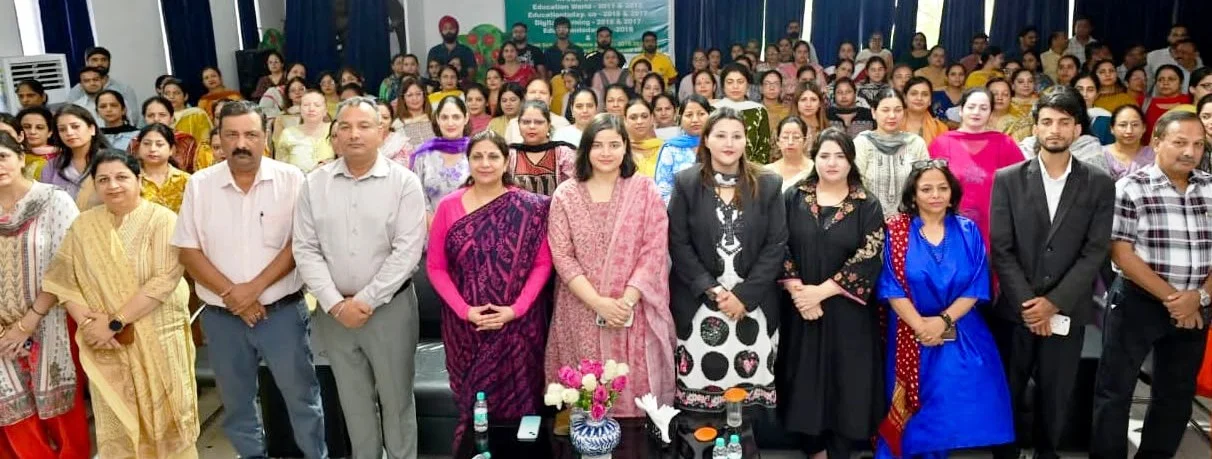
JAMMU, SEPTEMBER 17: District Legal Services Authority Jammu, under the guidance of Principal District & Sessions Judge/Chairman, DLSA Jammu Tahir Khurshid Raina and under the supervision of Civil Judge (Sr. Division)/Secretary, DLSA Jammu Maleeka Sharma, today organised an awareness programme on Juvenile Justice (Care and Protection of Children) Act, 2015 at Delhi Public School Jammu.
Resource persons were Adv. Ifra Nasir, Panel Lawyer, DLSA Jammu, Adv. Uma Kapahi, Panel Lawyer, DLSA Jammu along with Maleeka Sharma, Secretary, DLSA Jammu.
Secretary, DLSA Jammu in her address, stated that it is both an honour and a responsibility to speak on a law that sits at the heart of our collective duty towards children. She emphasised that teachers are not merely instructors of curriculum but are the first responders in a child’s ecosystem. She explained that the JJ Act is not only for police, magistrates or child welfare officers but for every adult who interacts with children daily, as teachers often see the first signs of distress, neglect, exploitation or behavioural change.
She elaborated that the law classifies children into two streams i.e. Children in Conflict with Law (CCL) – those alleged or found to have committed an offence and Children in Need of Care and Protection (CNCP) – those who are orphaned, abandoned, trafficked, abused, working illegally, begging or living on the street. She informed that for CNCP, the Child Welfare Committee (CWC) decides placement, rehabilitation and restoration and for CCL, the Juvenile Justice Board (JJB) conducts inquiry and orders rehabilitative measures.
She further explained the categorisation of offences as petty, serious and heinous and the critical provision under Section 15 which allows preliminary assessment for a child aged 16-18 years alleged to have committed a heinous offence. She clarified that if the JJB, aided by experts, finds the child possessed sufficient mental and physical capacity to commit the offence and understand its consequences, the case may be transferred to a Children’s Court for trial as an adult and that this is exceptional, not routine and always subject to safeguards.
She urged the teachers to ensure mandatory reporting of any apprehension of child abuse, trafficking, forced labour or missing child to Childline 1098, local police or CWC/JJB, to maintain confidentiality and not disclose names or photographs of children involved in any proceeding, to watch for red flags like unexplained injuries, frequent absenteeism or sudden drop in performance and to support rehabilitation and social reintegration of children. She concluded that the courtroom may pass orders but teachers shape the environment where those orders succeed or fail and that every child who walks through the school gates must be seen, heard and protected as a rights-holder under the law.
Adv. Ifra Nasir, in her address, apprised the participants about the concept and objective of free legal aid. She explained that legal aid is a constitutional right under Article 39-A of the Constitution of India. She informed the gathering about the categories of persons entitled to free legal aid, including women, children, persons belonging to SC/ST, victims of trafficking, industrial workmen, persons with disabilities, persons in custody and persons whose annual income is below the prescribed limit.
Adv. Uma Kapahi delivered a detailed lecture on the Juvenile Justice (Care and Protection of Children) Act, 2015. She explained that the Act is a comprehensive legislation to ensure care, protection, development and social reintegration of children. She also explained the classification of offences into petty, serious and heinous offences and the special provision of preliminary assessment in case of heinous offence committed by a child in the age group of 16 to 18 years. She further sensitised the teachers about corporal punishment, child labour, child trafficking and POCSO Act and emphasised that the best interest and welfare of the child is the paramount consideration under the Act.