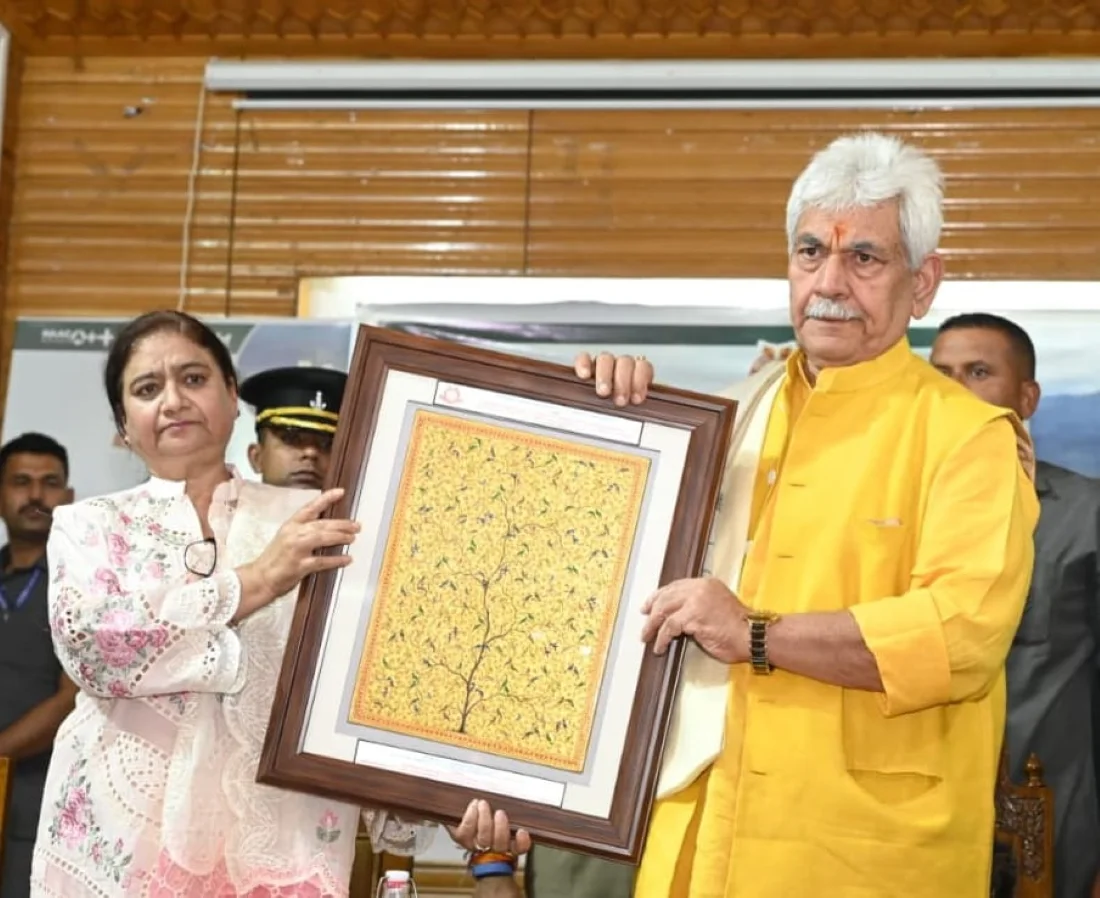
SRINAGAR, SEPTEMBER 17: The Lieutenant Governor, Shri Manoj Sinha today attended the Valedictory Session of National Seminar on “Environment, Climate and Sustainability: Science, Policy and Pathways”, held at Kashmir University. The three-day conference brought together ecologists, hydrologists, soil experts, policy makers, and researchers from across the country to deliberate on pressing environmental challenges.
In his address, the Lieutenant Governor lauded the national-level seminar for creating a shared language among diverse disciplines to collectively address the climate crisis. He underscored that climate change, biodiversity loss, and pollution are not isolated phenomena but interconnected dimensions of the triple planetary crisis. Recognizing the finite and interlinked nature of Earth’s systems, he emphasised the need for holistic approaches that transcend departmental silos in governance.
“Although government machinery has separate departments. One department formulates water policy, another forest policy, and yet another climate policy. But, I strongly believe such national seminars remind us that there is a deep connection among all these, and acknowledging it is the first step toward solving these problems,” he said.
Highlighting the role of technology, the Lieutenant Governor described Geospatial Intelligence, including GIS, remote sensing, UAVs, as the lifeline connecting science and governance. He stressed that anticipatory governance must replace reactive responses, enabling real-time decisions through tools such as Climate Sensitivity Maps and Spatial Decision Support Systems.
“We must create systems that do not merely record what has already happened to a glacier, forest, or river valley, but can also tell us with full confidence what is going to happen next. And we must be able to deliver that information to those who today need to decide what should be built, where it should be built, and what should be conserved. I believe the role of scientists and environment experts is no longer just to describe change. They must become co-creators of early warning systems. The time when we waited five years for a report on a subject is gone. Now we must make real-time decisions,” the Lieutenant Governor said.
The Lieutenant Governor made a strong appeal to bridge the gap between science and policy. He said while data and models are abundant, institutional mechanisms to integrate scientific conclusions into district development plans, water distribution, and disaster management remain inadequate. He called for trust, collaboration, and shared language between scientists and policymakers to ensure timely and effective action.
“If we can bridge the distance between what science knows and what policy delivers in line with that knowledge, then even the biggest challenges related to climate change can be addressed. Today, we do not lack data on climate change. With the help of Artificial Intelligence, we also do not lack tools and models. What we lack is the institutional system and the institutional arrangements that can take conclusions emerging from a lab or satellite record and deliver them in time to a district’s development plan,” he said.
The Lieutenant Governor reminded the researchers and policymakers that development must be accompanied by responsibility, conservation, and duty. He urged young experts to think beyond disciplinary boundaries and policymakers to listen to the language of science.
“Development must mean establishing a relationship with the Earth in which use is accompanied by responsibility, progress by conservation, and rights by duties. Another important takeaway you will carry from this conference is that technological skills alone are not enough. We must prepare young researchers and scientists who can think beyond disciplinary boundaries, and we need policy makers who can listen to the language of science,” the Lieutenant Governor said.
Looking ahead to the vision of a Developed India by 2047, the Lieutenant Governor stressed that development must be climate-resilient and inclusive. He expressed hope that the dialogue initiated during the national seminar would continue beyond its conclusion, permeating laboratories, universities, districts, and policies, ultimately benefiting the people. He reaffirmed India’s commitment to sustainable development and climate resilience through science-policy integration, technological innovation, and cultural sensitivity.
Prof. Nilofer Khan, Vice Chancellor, University of Kashmir; Prof. Talat Ahmad, former Vice Chancellor, University of Kashmir; Dr. Rasik Ravindra, former Director, National Centre for Polar and Ocean Research (NCPOR); Prof. Shariefuddin Pirzada, Dean Academic Affairs, University of Kashmir; experts, policy makers, and researchers from across the country; senior officials, faculty and students attended the valedictory session.