
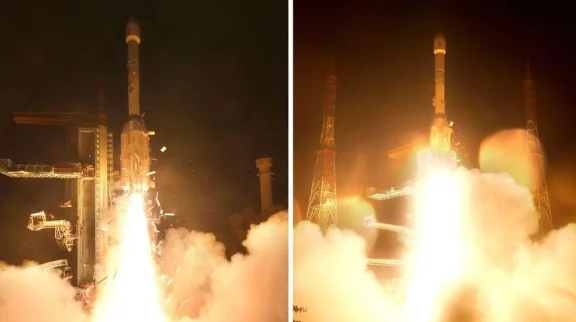
SRIHARIKOTA, SEPTEMBER 4: India’s space programme marked a significant milestone on Friday with the successful launch of the country’s first Earth-imaging satellite designed for deployment in geosynchronous orbit.
The Indian Space Research Organisation (ISRO) launched the EOS-05 satellite aboard the GSLV-F17 rocket from the second launch pad of the Satish Dhawan Space Centre here at 2.55 AM.
The 51.7-metre, three-stage GSLV-F17, carrying a payload mass of 2,367 kg, lifted off as scheduled after a smooth 27-hour countdown that began at 11.30 PM on Wednesday. Despite the early morning hour and rain, a large number of people gathered at the spaceport to witness and cheer the launch.
EOS-05 is designed to operate at an altitude of around 36,000 km above Earth, where it will travel in sync with the planet’s rotation. The satellite is expected to provide near real-time Earth imagery and support applications in areas such as agriculture and disaster management.
While several Earth observation satellites currently operate in low Earth orbit, EOS-05 is India's first imaging satellite intended for a geosynchronous orbit.
The GSLV-F17 is the 19th flight of India’s Geosynchronous Satellite Launch Vehicle. The rocket has a lift-off mass of about 420.5 tonnes and features a cryogenic upper stage.
The mission also represents a major follow-up to the unsuccessful GSLV-F10/EOS-03 mission in 2021. That mission was aborted about 307 seconds after liftoff, with a subsequent investigation attributing the failure to an anomaly in the cryogenic upper stage.
Friday’s launch comes after a gap of nearly eight months following a series of setbacks in India’s space programme. On January 12 this year, the PSLV-C62 mission, carrying 16 satellites, failed to place them into the intended orbit after an anomaly in its third stage.
An earlier attempt in May 2025, involving PSLV-C61 carrying EOS-09, also ended unsuccessfully following a motor pressure-related issue that caused a fall in chamber pressure.
The successful EOS-05 mission is therefore being viewed as an important boost for ISRO as it resumes regular launch activities and strengthens India’s Earth observation capabilities.