
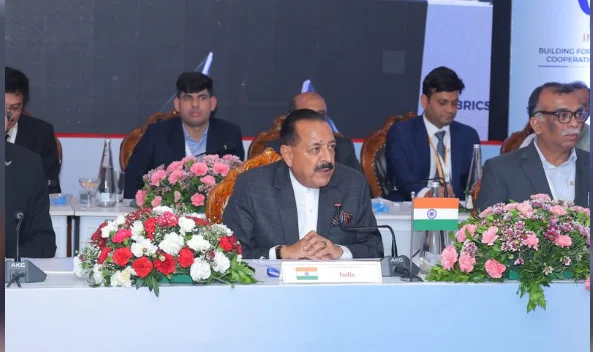
CHENNAI, Aug 22: India, as the BRICS Chair, on Saturday announced the unanimous adoption of the “Chennai Declaration”, reaffirming the grouping’s commitment to building an effective, resilient and future-ready framework for cooperation in science, technology and innovation.
Union Minister of State (Independent Charge) for Science and Technology and Earth Sciences and MoS PMO, Personnel, Public Grievances, Pensions, Atomic Energy and Space, Dr Jitendra Singh, made the announcement at the concluding session of the 14th BRICS Science Ministerial Meet.
The Chennai Consensus places a people-centric and humanity-first approach at the core of BRICS cooperation in science, technology and innovation, with emphasis on sustainable development, inclusive growth and the use of technology to improve people's quality of life.
Addressing the closing session, Singh said the deliberations had highlighted the crucial role of science, technology and innovation in building a resilient, inclusive and sustainable future. He said discussions covering artificial intelligence, high-performance computing, quantum technologies, advanced materials, biotechnology, healthcare, climate and sustainability reflected areas where BRICS nations could achieve greater results through collective action.
The declaration notes the expanding scope of BRICS STI cooperation, including 14 thematic working groups, 11 editions of the BRICS Young Scientist Forum, nine editions of the Young Innovators Prize and nine BRICS STI Framework Programme calls.
Singh said India's Chairship theme of “Building for Resilience, Innovation, Cooperation and Sustainability” should translate into concrete partnerships, stronger research networks, greater mobility of scientific talent, shared research infrastructure and enhanced opportunities for young researchers and innovators.
A key area identified for cooperation is shared research infrastructure and mega-science projects. The declaration welcomes progress towards operationalising the BRICS Global Research Advanced Infrastructure Network (BRICS GRAIN), which aims to facilitate access to research facilities, researcher mobility and collaboration on large-scale scientific infrastructure.
The Chennai Consensus also welcomes the development of the BRICS Science and Research Repository, envisaged as a digital platform for sharing information on scientific institutions, researchers, research outputs, datasets and research infrastructure, subject to national regulations and data-governance requirements.
The declaration places particular emphasis on young scientists, innovators and startups. It encourages greater exchanges under the BRICS Young Scientist Forum and Young Innovator Prize and welcomes initiatives aimed at strengthening links between incubators, accelerators and early-stage investors.
It also takes note of the BRICS Youth Startup Platform and discussions on a possible BRICS Startup Innovation Fund to support early- and growth-stage enterprises.
Singh said BRICS STI cooperation must move beyond dialogue towards tangible outcomes through joint projects, shared platforms, coordinated research calls and open access to research infrastructure.
He stressed that as BRICS expands, its scientific and technological cooperation should remain inclusive and responsive to the priorities of the Global South, ensuring that frontier technologies are accessible, affordable and responsibly deployed.
The Chennai Consensus covers cooperation in areas including AI, high-performance computing, biotechnology, healthcare, materials science, nanotechnology, photonics, astronomy, geospatial technologies, renewable energy, ocean and polar sciences, disaster management, quantum technologies and social sciences.
The meeting also endorsed the BRICS STI Calendar of Activities for 2026-27, ensuring continuity of various working groups and scientific initiatives. The next BRICS Science, Technology and Innovation Ministerial Meeting will be held under China's Chairship in 2027.
Singh thanked BRICS ministers, delegations, experts and officials for their contributions and said the spirit of resilience, innovation, cooperation and sustainability should continue to guide the grouping towards scientific excellence, technological progress and shared prosperity.