NEW DELHI, Aug 26: Union Home Minister Amit Shah on Tuesday set a one-year deadline for the complete implementation of the three new criminal laws, saying their effective enforcement could help ensure disposal of criminal cases up to the Supreme Court within three years and increase the conviction rate by 25 per cent.
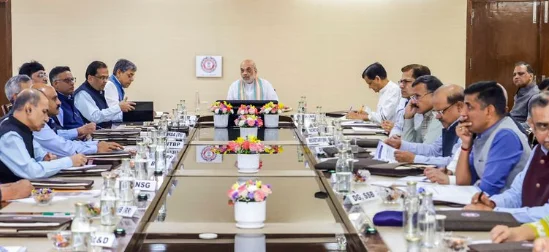
Addressing the valedictory session of the Intelligence Bureau's two-day ninth National Security Strategies (NSS) Conference-2026, Shah said the country must anticipate security challenges 15 to 20 years in advance and formulate strategies to prevent them from turning into major threats.
The Bharatiya Nyaya Sanhita (BNS), Bharatiya Nagarik Suraksha Sanhita (BNSS) and Bharatiya Sakshya Adhiniyam (BSA) came into force on July 1, 2024, replacing the British-era Indian Penal Code, Code of Criminal Procedure and Indian Evidence Act.
"There will be 100 per cent implementation of three new laws in the next one year, so that criminal cases can be disposed of up to the Supreme Court within three years and the conviction rate will increase by 25 per cent," Shah said.
He said an integrated database linking the Crime and Criminal Tracking Network and Systems (CCTNS), Inter-Operable Criminal Justice System (ICJS), NATGRID and National Automated Fingerprint Identification System (NAFIS) has been created.
Shah urged young officers to use data integration, analysis and artificial intelligence to develop actionable intelligence, identify criminal modus operandi and anticipate future security threats.
The Home Minister said the government had succeeded in addressing three major internal security challenges — Naxalism, terrorism in Jammu and Kashmir and insurgency in the Northeast — while crediting state police forces, central agencies and Central Armed Police Forces for the achievement.
He said earlier governments could have reduced the impact of problems such as narcotics, Naxalism and insurgency had they anticipated these challenges before they became acute.
Shah also cited the dismantling of the Popular Front of India (PFI) network and its subsequent ban as an example of effective Centre-state coordination.
On border security, Shah said he had visited all land-border states during the past eight months and shared a document outlining a quadrangular approach to strengthening border management.
"Our aim is to make the country free of infiltrators in a very short time," he said, describing infiltration as a threat to national security, the economy and demographic stability.