Trump Imposes New Tariffs on 60 Trading Partners Over Forced Labour Concerns
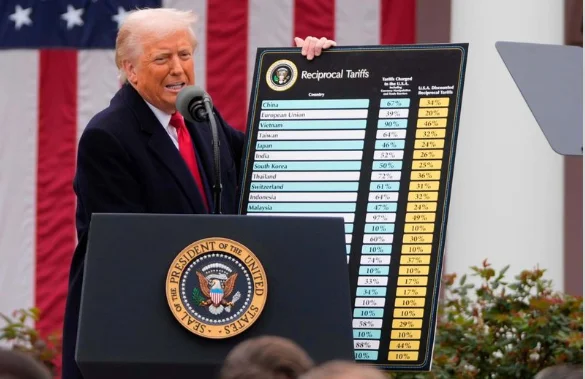
Washington, Jul 24: U.S. President Donald Trump has announced fresh tariffs ranging from 10 to 12.5 per cent on imports from 60 trading partners, replacing temporary worldwide levies that expire on Friday and citing inadequate enforcement of bans on goods produced through forced labour.
The new tariffs, which cover countries accounting for nearly 99 per cent of U.S. imports, will take effect as the administration’s temporary 10 per cent global tariffs lapse at 12:01 a.m. Friday.
U.S. Trade Representative Jamieson Greer said the measures were aimed at encouraging trading partners to strengthen action against forced labour.
“The United States has had a forced labour import ban for nearly a century and rigorously enforces it. It is well past time for our trading partners to do the same,” Greer said.
The tariffs are being imposed under Section 301 of the Trade Act of 1974, which allows the U.S. President to levy import duties against countries found to engage in unfair trade practices. Trump had previously relied on the International Emergency Economic Powers Act (IEEPA) to impose broad tariffs, but the U.S. Supreme Court ruled earlier this year that the law did not authorize such measures, forcing the administration to refund importers.
The administration said additional Section 301 tariffs could follow, with the U.S. Trade Representative currently investigating whether 16 countries have overproduced goods in a manner that harms American industries.
According to a senior administration official, some countries secured lower tariff rates after strengthening enforcement against forced labour. India’s proposed tariff, for example, was reduced from 12.5 per cent to 10 per cent.
Certain products, including oil, natural gas and fertilisers, have been exempted from the new duties. Goods qualifying for duty-free treatment under the US-Mexico-Canada Agreement (USMCA) will also remain exempt.
The announcement drew criticism from several countries and U.S. lawmakers.
Brazil described the move as “arbitrary and unjustified” and said it would consider retaliatory measures under its reciprocity law while filing a complaint before the World Trade Organization (WTO).
Chile also rejected the tariff, saying it maintains strong labour protections and that the U.S. decision was inconsistent with the evidence presented during the investigation.
In Washington, senior Democrat Richard Neal accused the administration of using forced labour concerns as a pretext for a broader tariff agenda.
Trade experts noted that tariffs are paid by U.S. importers, who often pass the additional costs on to consumers through higher prices, potentially adding to inflationary pressures ahead of the November midterm elections.
Human rights advocates offered a mixed response. While welcoming stronger action against forced labour, they cautioned that tariffs alone would not solve the problem and urged the U.S. to adopt a phased implementation along with support for countries seeking to strengthen enforcement mechanisms.
According to the International Labour Organization (ILO), an estimated 27.6 million people worldwide were living in conditions of forced labour in 2021. Human rights groups said import restrictions can be an effective tool when combined with transparency, enforcement and international cooperation.