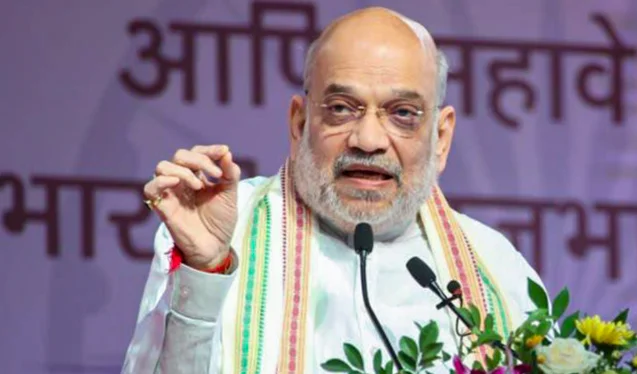
Mumbai, Sep 14: Union Home Minister Amit Shah on Monday said Maharashtra has the country's most multilingual culture with people here speaking several languages and asserted Hindi should act as a means of communication and connection among India's languages rather than competition.
He stressed cultural nationalism meant creating awareness about India's culture and history, asserting the country's diverse languages could have different voices, but the national sentiment should remain one.
All political differences must be set aside to promote Indian languages, Shah said while asserting that a child can understand the country only through his or her mother tongue.
Shah linked the promotion of Indian languages to Prime Minister Narendra Modi's pledge of freeing the country from a "mindset of slavery".
Addressing the 6th All India Rajbhasha Sammelan, organised on the occasion of Hindi Diwas, at Vashi in Navi Mumbai, Shah said legendary freedom fighter Bal Gangadhar Tilak had understood that awareness about the country's culture and history could be created through cultural nationalism.
Tilak started public Ganesh festivities and celebrations of Chhatrapati Shivaji Maharaj's birth anniversary, both festivals eventually spreading beyond Maharashtra, helping create a wave of patriotism during the freedom struggle, Shah said.
The minister said 'Hindi Shabd Sindhu', which began with 51,000 words, had now grown to eight lakh words and expressed confidence that it would become the world's largest dictionary by 2029.
Shah said more than 50,000 words from Indian regional languages had been incorporated into 'Hindi Shabd Sindhu' to fill gaps where Hindi lacked words. He said the dictionary had accepted words from Tamil, Telugu, Marathi, Gujarati, Bengali and Odia etc, thereby making Hindi more flexible.
Shah said Maharashtra has the country's most multilingual culture, with Marathi, Konkani, Gujarati, Sindhi, Hindi, Kannada and Warli among the languages spoken and developed in the state.
He said Prime Minister Modi had accorded Marathi the status of a classical language in 2024.
Shah emphasised Hindi should act as a means of communication and connection among India's languages rather than competition.
Social reformer Vinoba Bhave once said the use of Hindi had enabled him to take the message of the Bhoodan-Gramdan (land gift) movement nationwide, Shah noted.
The home minister, a senior BJP leader, said his knowledge of Hindi had helped him work across the country when his party assigned him a national-level responsibility.
He said the Rajbhasha department under the home ministry had developed the multilingual translation tool 'Bharati', while the government had set up 'Bharatiya Bhasha Anubhag'.
Shah invited elected representatives to communicate with the Centre in Marathi, assuring them arrangements were in place for translation.
The Centre wants to make Indian languages the language of governance and science, he said, adding that the aim is to enrich them through literature.
Candidates can appear for examinations such as IAS and IPS in their mother tongue, while JEE, NEET and undergraduate exam were being conducted in 13 languages, he pointed out.
"Political differences must be set aside to promote Indian languages. A child can understand India only through the mother tongue," Shah asserted.
PM Modi made imparting of primary education in one's mother tongue mandatory under National Education Policy (NEP), Shah added.
"The biggest work PM Modi has done is that, under NEP, he has made learning in mother tongue compulsory and also made learning another Indian language mandatory. Those opposing NEP provision of learning one more Indian language apart from mother tongue do not know what sin they are committing," he said.
Shah said more than five lakh Central government employees had undergone language training, while AI-based 'Kanthasth 2.0' had been made available to foreigners with more than five crore sentences. 'Leela Rajbhasha' and 'Leela Pravah' had been developed as language-learning resources.
He said nine volumes had so far been prepared by Rajbhasha Committee. Five of them would be dedicated during the Modi government's tenure.
Shah said the government had been taking the Rajbhasha conference to different states since 2019 instead of restricting it to Delhi.
He said several publications were released during the day, including 'Rajbhasha Bharati' (Vande Mataram special issue) and 'Vande Mataram Ke 150 Adhyay'. The 'Hindi Shabd Sindhu' digital resource and training in Hindi typing and shorthand were also launched, while 'Rajbhasha Kirti' and 'Rajbhasha Gaurav' awards were presented.
Speaking on Vande Mataram, Shah said it took 80 years to restore full glory of the national song.
"Vande Mataram is not merely a song but an effort to awaken Indian consciousness to get freedom. It laid the foundation of India's cultural nationalism," he said.
The song was later split and it took decades to restore it to glory, Shah said referring to an old decision to just sing the first two stanzas at official events.
Vande Mataram regained its glory and began to be sung in full at all government functions because India got a prime minister like Narendra Modi, he said.
Shah said Chhatrapati Shivaji Maharaj had treated 'Swaraj', 'Swadharma' and 'Swabhasha' as integral parts of self-rule and had accorded importance to Marathi in governance.
Modi had consistently delivered speeches in Hindi or other Indian languages at major international forums, Shah said.
Citing Rabindranath Tagore, Shah compared Indian culture and literature to a many-petalled lotus, with each regional language forming a petal.
"Languages could remain many, but the sentiment should remain Indian and India's voice should remain one," the Union minister asserted.
Chief Minister Devendra Fadnavis, Deputy CMs Eknath Shinde and Sunetra Pawar also spoke at the conference.
Fadnavis urged citizens to respect all Indian languages equally, noting mother-tongue education significantly improves learning capacity and administration.
Shinde highlighted the shared heritage of Marathi and Hindi as sister languages written in the Devanagari script and called for expanded use of Indian languages in law, science, and technology.
Pawar emphasized simplifying administrative language so that official communications remain accessible to people.