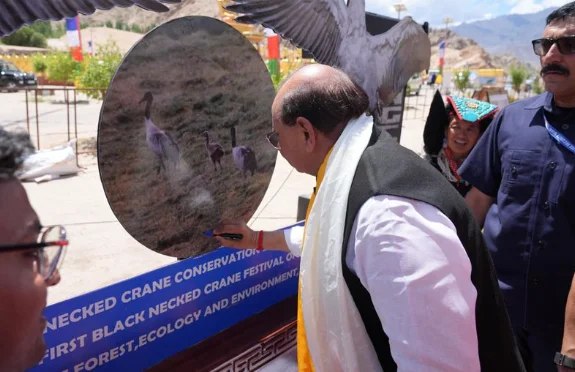
LEH, Aug 11: Lieutenant Governor Vinai Kumar Saxena on Tuesday inaugurated the nation’s first Black-Necked Crane Festival 2026 in Ladakh, aimed at promoting conservation of the endangered species while strengthening environmental protection, sustainable tourism and livelihood opportunities for local communities.
The festival brought together conservationists, researchers and wildlife experts from India and abroad, including representatives from the United Nations, Bhutan and Nepal, which are home to significant populations of the Black-Necked Crane.
Around 16,000 Black-Necked Cranes are estimated to inhabit regions across India, Bhutan, China and Nepal. The species is the world’s only alpine crane and is adapted to some of the highest-altitude environments. Ladakh is the only breeding ground of the Black-Necked Crane in India, making the region crucial for its conservation.
The UT Administration has recognised the ecological and cultural importance of the species by declaring the Black-Necked Crane as Ladakh’s State Bird. It is also regarded as a symbol of peace and an emblem of the region’s unique high-altitude ecosystem.
Addressing the gathering, Saxena stressed that protecting the Black-Necked Crane must go hand in hand with safeguarding Ladakh’s wetlands, grasslands and other fragile high-altitude ecosystems.
He highlighted the importance of wetlands such as Tso Kar and Hanle, saying these landscapes support biodiversity, regulate water systems and sustain pastoral communities.
The LG emphasised that local communities should be treated as partners and custodians of conservation efforts, with traditional knowledge integrated with modern scientific approaches.
“The Black-Necked Crane is much more than a bird. It is a symbol of peace, an ambassador of our high-altitude ecosystem and a bridge between wildlife conservation and the well-being of our communities,” Saxena said.
He also underlined the potential of responsible birdwatching, nature tourism, wildlife photography, handicrafts and traditional products to generate sustainable economic opportunities for local communities.
The festival featured a Community Knowledge Circle and Community Eco-Market, showcasing efforts to link environmental conservation with local culture and livelihoods.
Saxena called for a development model based on “more value from nature, with less pressure on nature”, stressing that tourism and economic activity should not damage the fragile ecosystems that attract visitors to Ladakh.
The festival also focused on protecting breeding grounds and wetlands from pollution, unregulated tourism and other threats, besides creating greater public awareness about the species.
On the occasion, the LG released several publications and knowledge products on Black-Necked Crane conservation, including the Black-Necked Crane: India Book, Black-Necked Crane: Bhutan Book, a coffee table book, a conservation action plan, a status and distribution report, and the Bird Economy Status Report.
A special postal cover and cancellation were also released in collaboration with India Post, along with the Ladakh Declaration for Black-Necked Crane Conservation.