LEH, Aug 20: Ladakh has begun utilising nearly 90 million litres of glacier water every day for irrigation and agricultural development under an initiative spearheaded by Lieutenant Governor Vinai Kumar Saxena, officials said.
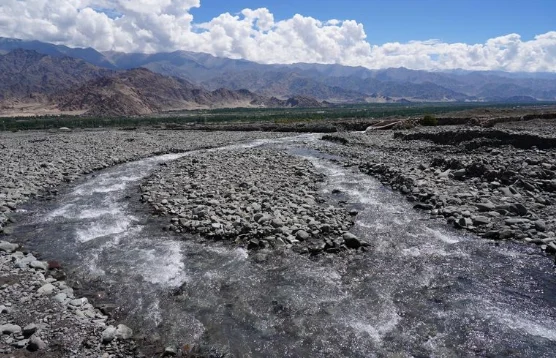
The water, which earlier flowed untapped into the Indus River as glacial runoff from Stok village Nallah in Leh, is now being channelised into the Igoo-Phey Irrigation Canal.
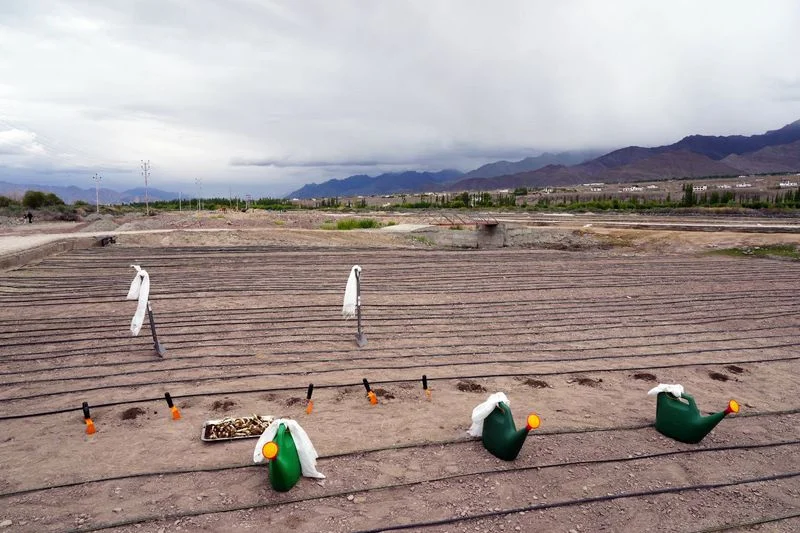
The initiative is expected to benefit nearly 12 villages and improve irrigation across more than 1,000 acres of land that had remained largely barren due to inadequate water supply.
Officials said the intervention was carried out through simple earthwork without any capital expenditure. On the LG’s directions on August 14, the Irrigation and Flood Control Department created two trenches using a JCB to divert excess water from Stok Nallah into the canal.
The Stok Nallah, fed by the Stok Kangri Glacier, has a discharge of around 36.60 cusecs, equivalent to approximately 90 million litres a day. Of this, 26 cusecs has initially been diverted, with 19 cusecs directed towards Igoo and seven cusecs towards Phey. Plans are underway to utilise the remaining 10 cusecs.
The additional water is expected to increase the flow in the Igoo-Phey Canal from around 50 cusecs to nearly 80 cusecs. This will enable regular water supply to the 12 villages that previously depended on a restrictive irrigation roster due to limited availability.
The 43-km Igoo-Phey Canal was constructed between 1979 and 2005 but had suffered from inadequate water supply and eventually became defunct.
Saxena described the initiative as a model for sustainable water management in Ladakh and said similar interventions would be expanded across the Union Territory.
The administration has identified other streams, including Matho Nallah, Tuchik Chenmo Nallah, Tuchik Chon Nallah and Stakna Nallah, for possible diversion projects.
Officials said the initiatives will focus on cost-effective, gravity-based engineering, minimal wastage and environmental sustainability, with the aim of improving irrigation, boosting crop yields, raising farm incomes and strengthening rural livelihoods across Ladakh.