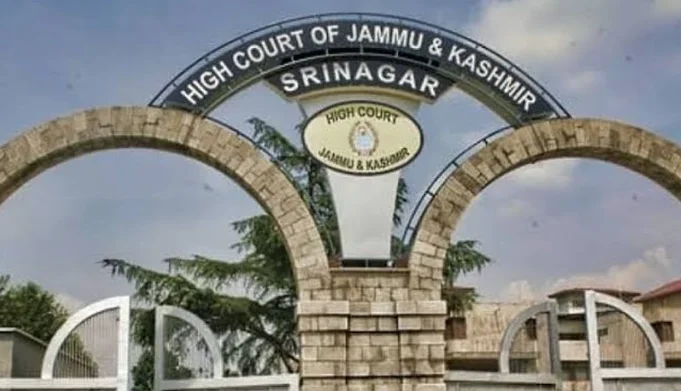
Srinagar, Aug 22 : The High Court of Jammu and Kashmir and Ladakh has flagged “legal shortcoming” and “insensitivity” on the part of a family court here for deploying police and issuing a search warrant to recover a five-year-old girl from her father.
Hearing a petition filed under Article 227 of the Constitution by Shadab Hussain Mir, a single bench of Justice Rahul Bharti observed that a father’s custody of his child “by no stretch of imagination could be illegal per se”.
The petitioner and respondent had dissolved their marriage through a settlement agreement that granted custody of their minor daughter to the mother, subject to the condition that custody would revert to the father if she remarried.
After the mother remarried, the father took the child into his care. The mother then approached the 4th Additional District Judge (Family Court), Srinagar.
On June 29, 2026, the Family Court ordered the SHO of Chanapora police station to execute a search warrant, recover the child and return her to the mother.
However, the High Court observed that the petitioner was acting as a concerned father under a mutually agreed written compromise dated January 25, 2025.
The agreement stipulated that custody would switch to the father if the mother remarried. Following the respondent’s recent remarriage, the father’s custody could not be prima facie branded as wrongful confinement or illegal custody, the court said.
Justice Bharti criticised the lower court for issuing an ex-parte search warrant without inviting the father’s response or examining the facts “inside out”.
The High Court said sending police to a father’s home showed judicial insensitivity, noting that if recovery of the child was necessary, well-meaning measures or a Women Police Cell should have been engaged instead of directing the local police station.
The bench also questioned whether a Family Court has the authority under Section 7 of the Family Courts Act, 1984, to exercise powers under Section 100 of the Bharatiya Nagarik Suraksha Sanhita (BNSS), 2023.
Justice Bharti noted that powers to issue search warrants under Section 100 of the BNSS are vested in District Magistrates, Sub-Divisional Magistrates or First-Class Magistrates, and not Family Courts.