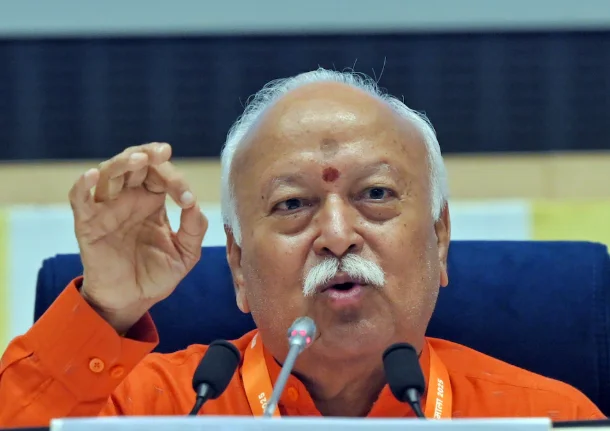
Ujjain, Sep 18 : RSS chief Mohan Bhagwat on Friday said that India's understanding of the concept of 'dharma' was distinct from Western notions of religion, asserting that the country has not discriminated among different faiths and this was its understanding of secularism.
Addressing around 1,700 Gen Z participants at the 'Yuva Dharma Sansad' here, Bhagwat said he was happy to see youngsters discussing 'dharma' at a time when some considered it an old people's affair.
"Our state has always been intermingling. It does not discriminate among its people. This is the meaning of 'panth-nirpekshata' for us," he said.
Bhagwat said the Western concept of secularism emerged from conflicts between rulers and religious authorities, and therefore, did not fit the Indian context in the same manner.
He said India had traditionally viewed material and spiritual aspects of life together rather than separating them.
The RSS has stepped up its outreach to Gen Z following a massive students' protest over NEET exam paper leaks at Jantar Mantar in Delhi, which brought youth discontent to the fore and led to the resignation of then Union Education Minister Dharmendra Pradhan.
Distinguishing 'dharma' and religion, Bhagwat said that the two should not be treated as synonymous.
'Dharma' is above religion, he said, adding that while the latter binds, the former liberates and leads to 'moksha' (salvation).
He noted that the English language had no exact equivalent for the Indian concept, and the word 'religion' had historically been used to explain it to Western audiences.
Bhagwat said religion could become sectarian when separated from 'dharma', which he described as being based on truth, compassion, purity and self-discipline.
"Dharma is not something to be discovered; it has to be recognised and practised," he said.
He described 'dharma' as a principle that sustains the universe, promotes the progress of all and determines duties, while taking into account the nature of every living being and object.
The RSS chief further noted that 'dharma' was reflected in human conduct and urged the young participants to shed prejudices if they wanted to understand it.
He also linked 'dharma' with environmental responsibility, saying human beings had a duty to protect nature and that destruction of forests and environmental degradation amounted to 'adharma' (unrighteousness).
He urged young people to respect other forms of worship while remaining committed to their own traditions.
Bhagwat said India's tradition sought to unite people rather than divide them and maintained that the country had historically tried to help even those who differed from it or caused it difficulties.
He also urged the youth to become successful as well as purposeful and contribute to creating a world marked by happiness and peace.
Around 300 scholars, teachers, researchers and religious leaders are participating in the Yuva Dharma Sansad, organisers said.
Chief Minister Mohan Yadav will attend the concluding session on September 19.
The three-day event, organised by Sevagya Sansthanam, is the sixth edition of the Yuva Dharma Sansad, following events in Kashi, Ayodhya, Mathura, Haridwar and Kanchipuram. The event will be held in Dwarka next year.