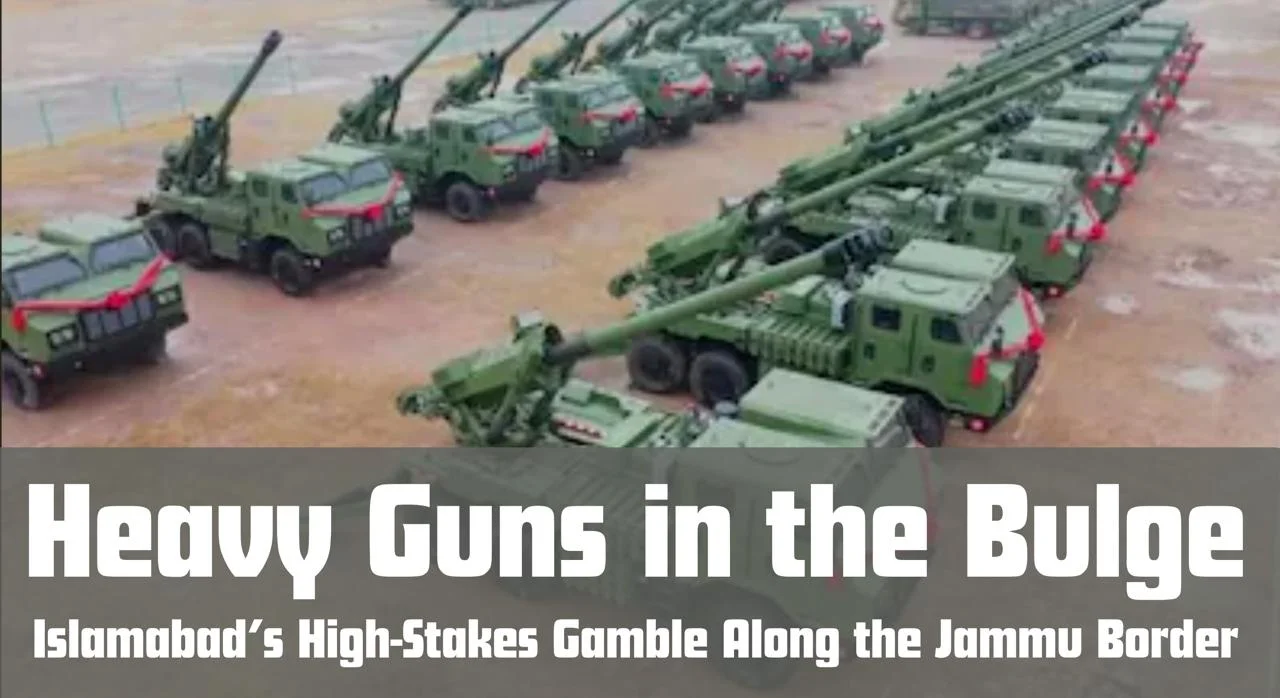
By Ravish Handoo Recent intelligence exposes a chilling move by the Pakistani military: the deployment of 250 Chinese-made, truck-mounted heavy howitzers directly along the international border. The artillery systems are SH-15 truck-mounted self-propelled howitzers. Manufactured by China's state-owned defence company NORINCO, they are the export version of China's PCL-181 system. Mounted on a 6x6 armoured truck chassis, they can travel at road speeds up to 90 km/h, allowing for rapid deployment and quick relocation before counter-battery fire can hit them. The 155mm/52-caliber guns can fire standard NATO-compatible ammunition at a range of 30 to 40 kilometres. When using rocket-assisted V-LAP projectiles, they can strike targets up to 72 kilometres away. This is not a routine military upgrade. It is a calculated, highly targeted threat aimed straight at the Indian plains. Clustered heavily in the Shakargarh bulge and the Sialkot sector, these highly mobile artillery pieces point directly toward the populated borders of Jammu. Capable of firing a deadly payload and relocating at highway speeds before counter-battery fire can strike back, these guns give Pakistan the ability to threaten vital Indian infrastructure without a single soldier crossing the border. This deliberate massing of long-range firepower turns a historically volatile sector into a ticking time bomb. This strategic layout is a dangerous ghost from 1965. It mirrors the exact blueprint of Operation Grand Slam, Pakistan’s ambitious armoured offensive aimed at capturing the Akhnoor bridge. Back then, Pakistani leadership viewed that narrow geographic corridor as India’s jugular, believing that severing it would cut off the entire Kashmir valley. Today, instead of sending tanks and infantry across the border, Pakistan is attempting to achieve the same goal through stand-off firepower. By positioning these heavy howitzers in the exact same launchpads used decades ago, they hope to choke the vital Jammu-Pathankot highway from the safety of their own territory. In 1965, the sheer resilience of the Indian armed forces utterly crushed that ambition. Today, history is poised to repeat itself. But this military standoff is not just a tactical game; it carries a severe, immediate risk to civilian lives. The entire city of Jammu, with its bustling markets and dense neighbourhoods, falls squarely within the extended kill zone of these modern shells. The danger is not abstract. During the intense border escalations of Operation Sindoor on the 10th of May, 2025, the night sky over Jammu lit up dramatically as Indian air defences frantically intercepted hostile projectiles. If a localized anti-terror strike could provoke such a reckless barrage over a sleeping city, the permanent presence of 250 heavy guns amplifies that threat exponentially. In the event of a skirmish, this artillery could turn a thriving economic hub into a frontline battlefield in minutes. India, however, is not waiting passively. The military has built a devastating counter-strategy that will thoroughly dismantle this nefarious plan. To hunt down the highly mobile Pakistani guns, India deployed its own K9-Vajra tracked howitzers, matching the enemy in cross-country mobility but vastly outclassing them in firing speed and armored protection. The indigenous Advanced Towed Artillery Gun System easily outranges Pakistan’s standard arsenal. But the absolute game-changer is India’s Swathi Weapon Locating Radar. Within seconds of a Pakistani gun firing, Swathi unblinkingly calculates its exact coordinates. Before the enemy crew can pack up and flee, Indian Pinaka multi-barrel rocket launchers are already saturating their grid with high explosives. Coupled with agile Integrated Battle Groups designed for lightning-fast cross-border strikes, India’s response guarantees the total destruction of the enemy’s artillery before they can do meaningful damage. To understand why Pakistan is taking this suicidal gamble, one must look away from the military maps and at their rapidly collapsing internal state. This aggressive posturing is a desperate attempt to distract from the explosive civil unrest currently tearing through Pakistan-occupied Jammu and Kashmir. For decades, Islamabad kept the people of POJK subdued with false narratives of shared prosperity and the illusion that Indian Kashmir would one day join them. Today, that illusion is dead. Sparked by crushing electricity tariffs and severe flour shortages, the protests have morphed into a full-blown civil rights movement. The Jammu Kashmir Joint Awami Action Committee is leading the charge against Islamabad’s exploitative rule, meeting brutal police and military suppression at every turn. The people of POJK finally realize they have been used as disposable pawns. Denied genuine political representation and given virtually zero reservation in government jobs, their resentment is boiling over into the streets. This internal awakening accelerated rapidly after the historic events of August, 2019. When the Government of India abrogated Article 370, making Jammu and Kashmir a directly administered and fully integrated part of the Union, it shattered Pakistan’s expansionist fantasies forever. New Delhi immediately backed this constitutional integration with thousands of crores in developmental schemes. While POJK suffers under a bankrupt economy unable to provide basic meals, the Indian side is witnessing a golden era of massive foreign investment, record-breaking tourism, and youth empowerment. The glaring disparity in human dignity and living standards is now too stark for the residents of POJK to ignore. They see a prosperous future that could have been theirs, contrasting sharply with their daily struggle for survival under a failing state. Nothing captures this widening developmental divide quite like the Udhampur-Srinagar-Baramulla rail link. The imminent reality of a direct train journey from New Delhi straight into the heart of Srinagar is a dazzling spectacle of engineering and modernity. Featuring the world's highest railway bridge over the Chenab river, the project is a towering testament to India's economic might. As the government prepares to launch state-of-the-art Vande Bharat sleeper trains on this route, even opposition political parties in India will unite to praise its monumental significance. When the disenfranchised people of POJK look across the heavily fortified border and see high-speed trains bringing immense trade and connection to their Kashmiri brethren, the psychological blow is profound. It serves as a daily, undeniable humiliation for the Pakistani establishment and adds uncontrollable fuel to the passions of the POJK people rallying against their government. Pakistan’s artillery buildup is a transparent diversion tactic engineered by a failing state. They are trying to manufacture a border crisis to artificially unify a deeply fractured nation against a fabricated external enemy. It is a doomed strategy. The Indian military of today is a technologically superior, fiercely motivated force equipped with the world’s most advanced radar networks. Any aggressive move against Jammu will be met with a disproportionate, punishing wall of fire. But the real victory extends far beyond the battlefield. It is being won by rapid economic progress and unshakeable constitutional integration. Pakistan’s big guns can never silence the roar of development in Jammu and Kashmir, nor can they muffle the desperate, undeniable cries for basic human dignity echoing across the border in POJK. In this broader, complex geopolitical and socio economic context, the menacing deployment of 250 heavy artillery guns along the peaceful Jammu border is completely exposed for what it truly is: a desperate, highly dangerous, and ultimately futile gamble by a rapidly failing state facing internal collapse. Pakistan is attempting to use the age old, predictable tactic of manufacturing a severe border crisis to artificially divert the attention of its rebellious, angry population and desperately try to unify a deeply fractured nation against a fabricated, external Indian enemy. By deliberately superimposing the historical ghost of Operation Grand Slam onto the modern tactical map, they foolishly hope to project a false image of military strength and resolve that masks their catastrophic internal political and economic weaknesses. But this aggressive military strategy is fundamentally flawed and doomed to catastrophic failure. The Indian military of today is absolutely not the army of 1965; it is a technologically superior, highly integrated, fiercely motivated, and incredibly well funded fighting force equipped with the world's most advanced radar and counter artillery systems. Any misguided attempt by the adversary to operationalize these big guns against the innocent civilian population of Jammu or the vital supply lines of the armed forces will instantly trigger a military response so precise, so overwhelming, and so utterly devastating that the hostile artillery batteries will be permanently reduced to twisted, burning metal before they can achieve even a fraction of their tactical objectives. The safety, security, and prosperity of Jammu remains the absolute paramount priority of the Indian state, and while the threat is geographically real and the traumatic memories of intercepted missiles occasionally linger in the public consciousness, the impenetrable protective umbrella of advanced Indian radar networks and retaliatory rocket forces ensures that the city and its people are heavily, flawlessly guarded day and night. Ultimately, the real, lasting battle for the future of the region is being decisively won not just with long range artillery and radar systems, but with unstoppable economic progress, firm constitutional integration, and the undeniable, visible power of human development. The historic abrogation of Article 370, the subsequent rollout of massive, life changing developmental schemes, and the highly anticipated, imminent arrival of the direct Delhi to Srinagar high speed train have already secured the ultimate psychological and moral victory for India. The suppressed people living across the border have finally seen the bright, undeniable light of progress, and absolutely no amount of heavy artillery placed in the Shakargarh bulge can ever silence their growing demand for the fundamental rights, economic prosperity, and basic human dignity that only a strong, democratic, and economically vibrant nation can provide. The nefarious, aggressive plans of the adversary are entirely destined to fail, guaranteed to be crushed by the immense dual weight of Indian military deterrence and the unstoppable, historic momentum of a resurgent, fully integrated, and rapidly developing Jammu and Kashmir.
Heavy Guns in the Bulge: Islamabad’s High-Stakes Gamble Along the Jammu Border