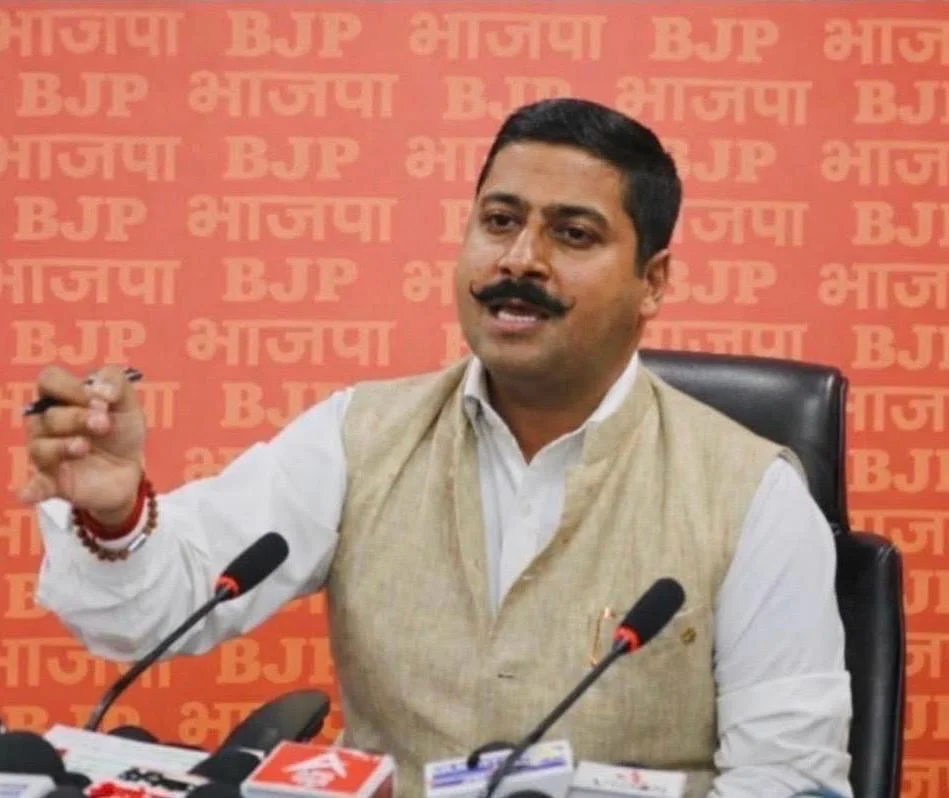
JAMMU: BJP Spokesperson and Convenor, International Affairs, J&K, Gaurav Gupta has welcomed the Union government’s initiatives to strengthen and modernise the Foreign Contribution (Regulation) Act framework, calling them essential for transparency, accountability and national security.
Referring to the Foreign Contribution (Regulation) Amendment Bill, 2026, Gupta said it would address legal and administrative gaps concerning foreign contributions and assets created through such funds when an organisation’s registration expires, is cancelled, surrendered or not renewed.
“The Modi government is not opposing genuine charity or legitimate international cooperation. It seeks to protect honest organisations while preventing foreign funds from being diverted towards activities detrimental to India’s sovereignty, security, public order or social harmony,” Gupta said.
He noted that India has one of the world’s largest voluntary sectors, with estimates suggesting more than three million NGOs. Some assessments place India’s share at nearly one-third of the estimated NGO ecosystem across G20 countries, making transparent and technology-driven regulation essential.
The Bill proposes a Designated Authority to supervise and manage foreign contributions and foreign-funded assets of organisations that no longer possess valid FCRA registration. Such funds and assets would initially be provisionally vested with the authority. If an organisation subsequently secures fresh registration or gets its certificate restored, the unutilised contributions and assets would be returned.
If it fails to regularise its registration within the prescribed period, the vesting may become permanent. The assets could then be transferred to a government department, agency or local authority for public use or disposed of through a legally prescribed process, with the proceeds credited to the Consolidated Fund of India.
Gupta said the mechanism would prevent schools, hospitals, institutions and buildings created through foreign donations from becoming unaccounted for or being transferred to private interests after an organisation becomes defunct. He also highlighted the safeguard requiring the religious character of any permanently vested place of worship to be preserved.
The reforms would further prescribe timelines under the prior-permission route, regulate assets during suspension and define the responsibilities of inactive organisations.
Responding to criticism by international human-rights groups and UN mechanisms, Gupta said certain statements and social-media posts had presented a one-sided narrative. In 2016, three UN Special Rapporteurs called for the FCRA’s repeal, while former UN Human Rights Commissioner Michelle Bachelet raised concerns in 2020 about its application to human-rights organisations.
“UN experts may express their opinion, but regulation of foreign contributions is India’s sovereign and internal matter. Indian laws will be decided by Parliament in accordance with the Constitution and national interest,” he asserted, adding that the Supreme Court has held that receiving foreign contributions is not an absolute or vested right.
“Countries raising questions over India’s FCRA must also acknowledge that the United States has its own Foreign Agents Registration Act (FARA), which is enforced strictly to ensure disclosure of foreign influence and overseas-backed activities. When other sovereign nations regulate foreign funding in their national interest, why should India face selective criticism for doing the same? External organisations should refrain from interfering in India’s internal legislative affairs,” Gupta said.
Gupta said nearly 16,000 associations reportedly receive around ₹22,000 crore annually in foreign contributions. “Every sovereign country has the right to know where foreign money originates, who receives it and how it is utilised,” he said.
He also praised Prime Minister Narendra Modi and Union Home Minister Amit Shah for FCRA 2.0, a fully digital portal incorporating Aadhaar authentication, e-signatures, OCR scrutiny and integration with PAN, NGO Darpan, banking systems and ICAI’s UDIN platform.
“FCRA 2.0 will simplify compliance for honest organisations and strengthen action against wrongdoing. Transparency should never concern genuine institutions,” Gupta concluded.