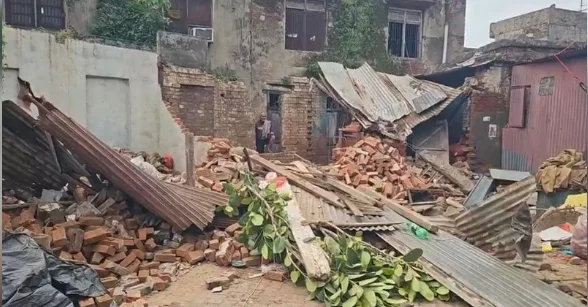
JAMMU, Aug 9: A demolition drive at the traditional Parade Sabzi Mandi in Jammu on Sunday triggered protests from traders, who alleged that the Jammu Municipal Corporation (JMC) acted without prior notice or adequate time to remove their goods and belongings.
A JMC team, accompanied by police and paramilitary personnel, carried out the drive around 7 am and demolished around 20 makeshift and concrete shops, officials said.
The action is part of the JMC’s Rs 5.88-crore smart city project to modernise and redevelop the congested vegetable market. The foundation stone for the project was laid on June 22.
President of the Vegetable and Fruit Association, Parade Sabzi Mandi, Subash Chander Sharma, alleged that the demolition was carried out in a “high-handed” manner despite ongoing discussions and repeated appeals by traders.
“We were not against modernisation and are willing to cooperate with the administration, provided the market is properly rebuilt,” Sharma said, adding that traders wanted facilities similar to modern mandis in Delhi, Chandigarh and Punjab.
He questioned the proposed six-foot-wide passages inside the redeveloped market, saying vegetable traders often bring several quintals or even tonnes of produce into the market.
The traders also alleged that no formal notice was served and claimed that several shops still contained stock when the demolition began, causing losses. Some also said they had obtained a court stay against the demolition.
The protesters said some of the shops had existed for nearly 100 years and had supported generations of families. They demanded alternative shop or vending space, adequate notice, compensation for genuine losses and a proper rehabilitation plan.
The JMC project envisages a covered Mild Steel shed with 117 vendor platforms measuring 1.8 metres by 2.1 metres each. It also includes 44 permanent commercial shop blocks measuring 2.4 metres by 2.7 metres, along with improved sanitation and other public amenities.
Traders said they were not opposed to redevelopment but wanted their livelihoods protected during the process.