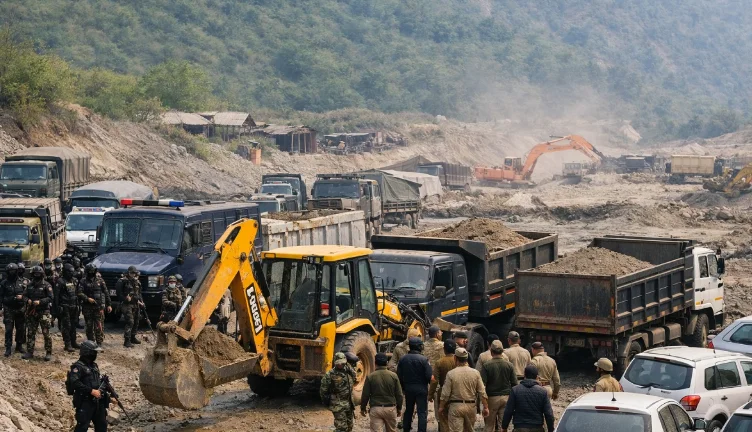
SRINAGAR, Aug 17: Jammu and Kashmir authorities recorded 9,417 seizures and registered 285 FIRs against illegal mining during the financial year 2025-26, recovering penalties amounting to ₹20.009 crore, according to official government data.
The figures have raised questions over the gap between enforcement action and criminal prosecution, with several districts reporting a high number of seizures but comparatively few or no FIRs.
Kathua recorded the highest number of seizures at 1,019, but only one FIR was registered. Kupwara reported 972 seizures and 48 FIRs, while Baramulla recorded 845 seizures and 41 FIRs. Samba reported 800 seizures but did not register any FIR.
Budgam recorded the highest number of FIRs in the Union Territory, with 62 cases registered against illegal mining offenders against 671 seizures. It was followed by Kupwara with 48 FIRs, Baramulla with 41, Ganderbal with 30 and Srinagar with 29.
Kathua also topped the districts in penalty recovery, with ₹3.308 crore collected. Jammu followed with ₹2.248 crore, Pulwama with ₹2.008 crore, Baramulla with ₹1.618 crore and Kupwara with ₹1.499 crore.
Among other districts, Anantnag recorded 530 seizures and recovered ₹1.01 crore in penalties, while Kulgam reported 391 seizures and collected ₹94.9 lakh.
In the Jammu division, Jammu district recorded 679 seizures, 15 FIRs and ₹2.248 crore in penalty recovery. Reasi reported 356 seizures, while Rajouri and Udhampur recorded 317 and 277 seizures, respectively.
Ramban recorded the lowest number of seizures at 39, followed by Kishtwar with 58. Neither district registered an FIR during the period.
The disparity between the number of seizures and FIRs came under scrutiny during a recent meeting of the Committee on Environment chaired by M Y Tarigami.
The committee expressed concern over the variations in enforcement across districts and sought a detailed explanation from the Mining Department.
Tarigami directed the department to provide comprehensive details of the first and second penalties imposed on violators before the seizure of vehicles, machinery or minerals. He said the information was essential to assess the effectiveness of the existing enforcement mechanism and determine whether the current action against illegal mining was adequate.