CM Omar Abdullah, Estranged Wife Payal Seek Mutual Divorce in Supreme Court
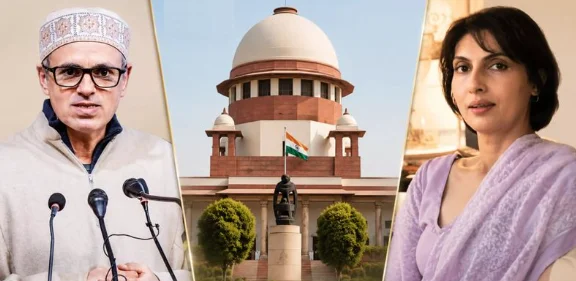
New Delhi, Jul 31: Jammu and Kashmir Chief Minister Omar Abdullah and his estranged wife, Payal Abdullah, have agreed to dissolve their marriage by mutual consent and have jointly approached the Supreme Court seeking a divorce under Article 142 of the Constitution.
The development was disclosed before a Bench comprising Justice P.S. Narasimha and Justice Alok Aradhe on Friday. Senior Advocate Kapil Sibal, appearing in the matter, informed the Court that both parties had “embraced freedom” and had filed a joint application on July 22 requesting the apex court to grant a decree of divorce by mutual consent.
Taking note of the submission, Justice Narasimha said the Court would pass appropriate orders on the application.
The Bench was also informed that Omar Abdullah and Payal Abdullah have agreed to withdraw all legal proceedings initiated against each other. The Court said this understanding would form part of its final order while disposing of the matter.
The case reached the Supreme Court after Omar Abdullah challenged the Delhi High Court’s decision refusing to grant him a divorce. Earlier, the apex court had referred the matter to the Supreme Court Mediation Centre in an effort to facilitate an amicable settlement.
Omar Abdullah and Payal Abdullah were married on September 1, 1994, and have been living separately since 2009. They have two sons.
Omar Abdullah had initially sought divorce before the Family Court on the grounds of desertion and cruelty. However, the Family Court dismissed his petition on August 30, 2016, holding that he had failed to establish an irretrievable breakdown of the marriage. The Delhi High Court upheld that decision in December 2023, prompting Omar Abdullah to move the Supreme Court.
With both parties now consenting to end their marriage, the Supreme Court is expected to formally dissolve the marriage by exercising its powers under Article 142 of the Constitution, which enables it to pass orders to ensure complete justice between the parties.